Marchbolt Golf Course
Why Didn't They Ask EvansMarchbolt Golf Course turns an ordinary round of golf into the point of entry for the novel’s mystery: Bobby Jones’s progress across its holes brings him to a body beneath the cliffs, while a later game with Frankie Derwent makes the course a place where a forgotten detail returns to him. Its fairway, bunker, furze, and cliff-edge holes give the discovery a physical route, and golf’s pauses and repeated shots shape the movement from accident to recollection.
Setting and Layout
The course is presented through the obstacles and landmarks that Bobby encounters in play. At the fourteenth, his shot is meant to travel over a bunker and finish within an easy mashie shot of the green; instead, he tops it and the ball lodges in the bunker. The detail establishes golf here not as a smooth passage across open ground but as a succession of difficult shots and imperfect outcomes.
The next tee lies at the edge of a cliff. The seventeenth requires a drive over a chasm, although Bobby knows the distance is not especially great. His difficulty is psychological as well as technical: the depths below overpower his confidence, and the ball disappears over the lip of the abyss. The course’s holes therefore bring play directly alongside a hazardous landscape, making the border between a sporting mishap and a more serious discovery unusually thin.
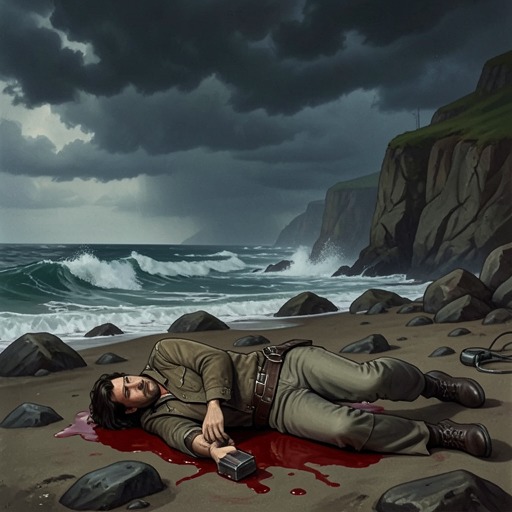
The terrain has more than one level of access. From above, the sea is visible far below; the cliff is sheer at the top but shelves more gradually beneath it. Bobby knows a place where someone can scramble down, as caddies do when retrieving lost balls. That practical knowledge of the course’s contours becomes consequential when he spots a dark heap around forty feet below.
The Discovery Beneath the Cliffs
The discovery follows a sequence of distractions and uncertain perception. While playing with Dr Thomas, Bobby makes a poor shot and hears what may be a shout. The light is difficult: the sun is setting directly in his line of sight, and mist is rising from the sea. He cannot see clearly, and Dr Thomas hears nothing. Bobby also reasons that his ball could not have travelled as far as the footpath, which runs near the cliff, but the possibility that someone called out remains unresolved.
After retrieving the ball from a furze bush, Bobby gives up the hole. Dr Thomas comes over because the next tee is close to the cliff edge. Only after Bobby has driven across the chasm and lost sight of his ball does he walk along the edge and notice the heap below. The course’s ordinary routines—searching for a ball, abandoning a hole, moving to the next tee—carry the two men into the scene of the discovery. The body is first seen from above, as an indistinct shape against the drop, rather than encountered on the playing ground itself.
The course thus supplies both the circumstances that delay recognition and the route by which Bobby reaches the view of the body. Poor visibility, the sea mist, the setting sun, and the distance below make the first sighting uncertain; Bobby’s familiarity with a scramble down the cliff offers a way to investigate. These details make the location active in the scene without suggesting that the discovery was planned: the hazard belongs to the course, but the mystery begins when play brings Bobby to its edge.
Golf, Recollection, and the Mystery
The course also recurs after the discovery. Bobby and Frankie Derwent set off for a round after their conversation has turned amicable, and they talk about slicing, pulling, and improving a chip shot. For a time, the recent tragedy passes out of Bobby’s mind. At the eleventh hole, however, he suddenly remembers that the Caymans had asked whether the dying man said anything before he died. Bobby had answered that he had not, but now realizes that the man did say something; it was simply not what the Caymans had meant by their question.
The scene makes the course a setting for a different kind of search. In the opening, Bobby follows the physical evidence of a lost golf ball and finds a body. Later, amid familiar talk about shots and greens, a detail he had failed to recognize resurfaces in memory. The eleventh hole does not resolve what the man said, but it changes Bobby’s understanding of his earlier answer and points him back toward the mystery.
Across these scenes, the course links chance, observation, and delayed recognition. Its cliff-edge geography gives the opening its danger; its everyday pattern of holes and play makes room for the later recollection. The contrast is central to its narrative function: the same setting that first turns a round of golf into an encounter with death later turns another round into a renewed act of attention.